 Q&N Fashion Factory
Where to Buy Makeup Bags: The Ultimate Sourcing Guide (for Brands & Retailers)
Sourcing makeup bags for a brand or retail business is rarely difficult because you “can’t find suppliers.”
The real pain points are scattered information, inconsistent quality, non-standard pricing, and missing compliance documents.
Good news: once you understand the right sourcing channels and build a repeatable supplier-verification process, you can dramatically reduce trial-and-error costs, control lead time and quality, and source the exact makeup bags you want—fast.
This guide covers:
- The most common and effective sourcing channels (online + offline)
- A systematic framework to screen reliable factories (certifications, capacity, QC, compliance, case proof)
- Pricing logic & typical price ranges (broken down by material/process)
- A “must-ask” supplier question list (copy & paste ready)
1) Quick Answer: Where Can You Buy Makeup Bags?
You can typically source from these 4 major channels (ranked from most suitable to least suitable):
1) Google Search: Factory/Manufacturer Websites (Best for Custom & Long-Term Partnerships)
Search on Google using keywords like “makeup bag factory,” then shortlist verified manufacturers (especially in China) for customization and better unit pricing—this is one of the most popular approaches.
Keyword examples:
cosmetic bag manufacturermakeup bag factorytoiletry bag OEM/ODMclear PVC makeup bag supplier
Advantages
- Faster access to source factories
- Better for custom development, new designs, stable repeat orders
- Easier to align on materials, sampling, lead time, QC standards, after-sales responsibility
Risks
- A professional website ≠ a reliable factory
You still need a verification process (templates provided below).
Why prioritize “direct factory websites”?
Because you can negotiate directly on materials, sampling, delivery schedules, QC standards, after-sales responsibility, and long-term development—reducing markups and information loss from middle layers.
2) B2B Platforms (Best for Fast Supplier Comparison & Sampling)
Platforms like Alibaba are useful for discovering and comparing suppliers quickly. They’re great for collecting quotes, requesting samples, and testing multiple product directions before scaling production.
Typical platforms:
- Alibaba
- Global Sources
Advantages
- Dense supplier listings for easy comparison (price/MOQ/hot styles)
- Some platform-level trade assurance / dispute mechanisms
Risks
- One factory may appear as multiple storefronts / identities
- Quotes and lead times can be inconsistent across listings
- Must verify whether the supplier is a real manufacturer or a trading company
3) Wholesale Distributors / In-Stock Websites (Best for Small Batches, Low MOQ, Fast Delivery)
Best for
- Testing the market
- Pop-up events / gift sets
- Urgent replenishment
Advantages
- Low MOQ
- Fast lead time
Limitations
- Limited customization
- Higher unit cost than factory bulk orders
- Styles can be more “homogeneous” (less unique)
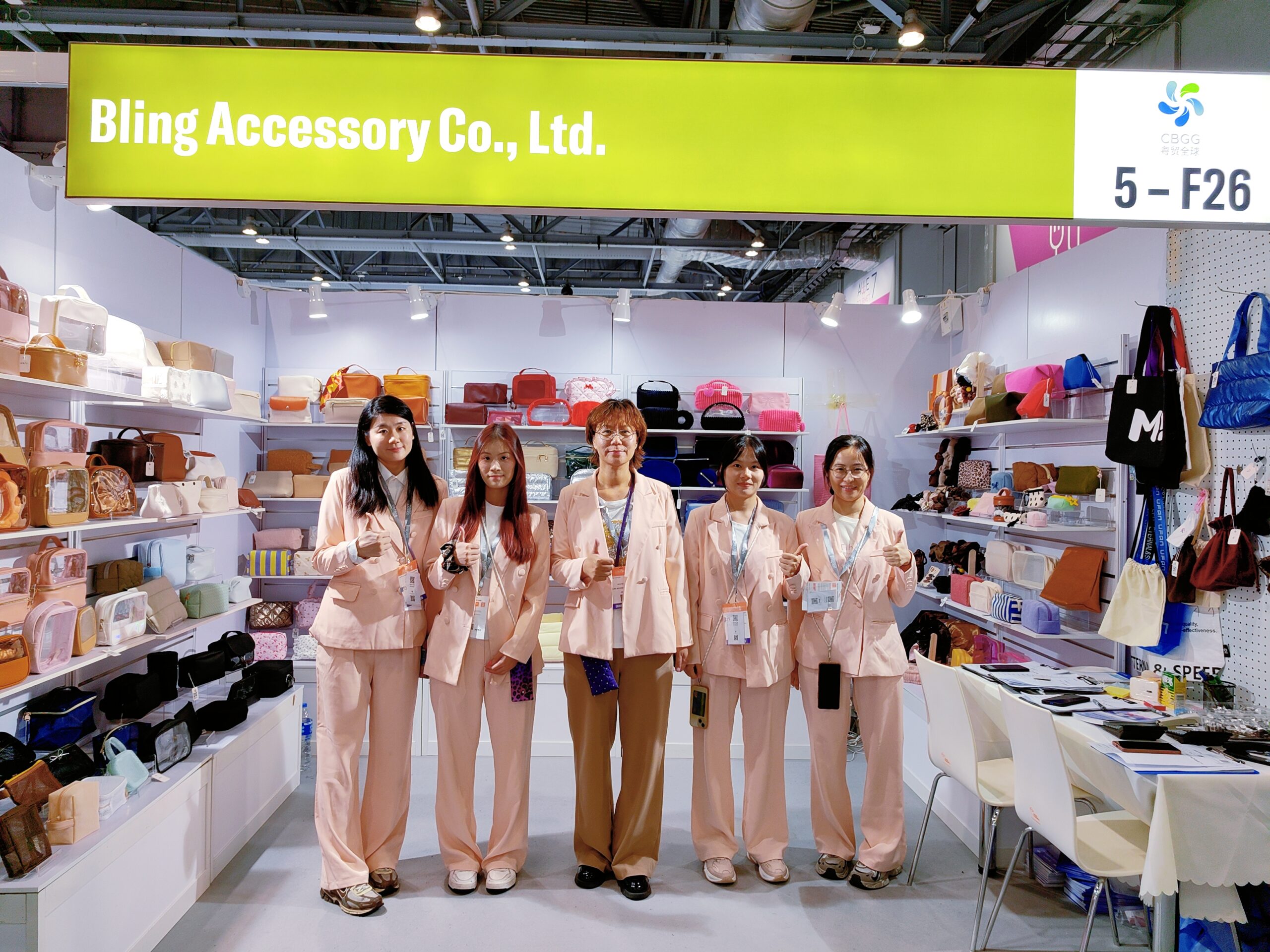
4) Trade Shows (Best for Face-to-Face Validation & Trust Building)
Examples include industry trade shows, packaging expos, gift fairs, etc.
Advantages
- See samples and craftsmanship details in person
- Evaluate team responsiveness and communication
- Easier to negotiate long-term cooperation face-to-face
Limitations
- Travel cost
- Fast-paced environment—without a question checklist, it’s easy to forget what you learned
2) How to Choose a Reliable Makeup Bag Manufacturer
A Simple but Effective Verification Framework
Many suppliers look strong online but fail in production. Use this 5-step screening method to reduce risk.
Step 1: Verify Compliance & Certifications (Good to Have—But Don’t Rely on Certificates Alone)
Common audits/certifications include:
-
ISO 9001 (Quality Management System): focuses on consistent processes and continuous improvement.
Learn more: ISO 9001:2015 overview (ISO) -
BSCI / amfori BSCI (Social Compliance Audit): evaluates social compliance through on-site observation, interviews, and document checks.
Learn more: amfori BSCI official introduction
Reminder: a certificate is not a “magic pass,” but it does show the supplier has a system that can be audited and managed.
Reference: ISO 9001:2015 (ISO)
Step 2: Confirm Capacity & Lead Time Fit Your Plan
Ask for quantified answers, not vague promises:
- How many sewing lines / machines?
- How many workers per line? Do you add overtime or extra lines in peak season?
- Monthly capacity for similar bags?
- Peak vs. off-season lead time difference? Can you provide a lead-time range (not just “yes, we can”)?
How to judge
- A reliable factory explains capacity with clear numbers and a realistic production schedule logic.
Step 3: Focus on the Quality System (QC Execution Is the Real Differentiator)
Ask them to share their QC process (ideally with forms/standards), including at least:
- Incoming Quality Control (IQC) for materials
- In-Process Quality Control (IPQC) during production
- Final Quality Control (FQC) for finished goods
- Packaging checks (logo placement, barcode labels, carton marks, packing list, etc.)
Step 4: Verify “Evidence You Can Validate” (Cases / Customer Structure / Repeat Orders)
Ask:
- Which markets do you mainly serve (US/EU/Japan, etc.)?
- Can you share non-confidential case examples (materials, workmanship, lead time, how issues were handled)?
- What’s your repeat-order rate? Typical cooperation duration?
What matters most
- Not “big-name logos,” but whether they can clearly explain:
what problems they solved and how they prevent recurrence.
Step 5: Use Samples + a Small Trial Order to Turn Risk Into a Controlled Cost
Before mass production, validate with sampling and a trial order:
- Material & color matching accuracy
- Logo method stability (hot foil, screen print, embroidery, metal plate, etc.)
- Zipper smoothness, stitching strength, bag structure/shape
- Packaging and labeling compliance requirements
3) What’s the Price Range?
The Core Pricing Logic Behind Makeup Bags
Price does “depend on materials,” but more precisely:
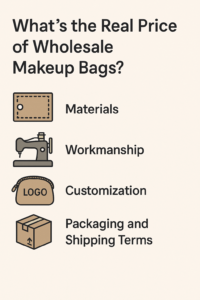
Price = Materials + Process Complexity + Size/Structure + Hardware/Trims + Printing/Logo + Packaging + Quantity Tier + Trade Terms (EXW/FOB, etc.)
(1) Standardize the Quote Term First: EXW vs. FOB Changes the Unit Price You See
International trade uses Incoterms to define responsibility and cost boundaries. Different terms change what’s included in the quote.
- Official reference: Know Your Incoterms (International Trade Administration)
- EXW explained (Incoterms 2020 context): Incoterms® 2020: EXW or FCA? (ICC Academy)
- Incoterms rules overview: Incoterms® rules (ICC)
Example:
- EXW usually means the seller delivers at their premises; loading, export clearance, and transport costs/risks are on the buyer.
Reference: ICC Academy article
Before comparing quotes, unify the price basis.
A “$2/pc” EXW quote and a “$2/pc” FOB quote are not directly comparable.
Reference: International Trade Administration
(2) Typical Industry Reference Ranges by Material (China Factory Basics)
Below are common reference directions for basic styles from Chinese factories (often seen around 500–3000 pcs). Actual pricing varies by size, lining, print coverage, hardware count, packaging, and seasonal capacity.
- Polyester/Nylon basic zipper pouch: entry-level, great for volume
- Canvas/Cotton: strongly affected by print method (digital vs. screen printing)
- PU leather: depends on thickness, backing, embossing, sewing structure; piping/stiffener increases cost
- Clear PVC/TPU: film thickness, eco requirements, heat-seal vs. binding methods affect cost
- Neoprene: higher material cost but strong shaping/functionality
- Quilted/padded/multi-layer constructions: more steps, more time → higher price
- Metal accessories/chains/complex hardware: hardware + assembly increases cost
- Premium packaging (gift box, inner tray, barcode labels, multilingual inserts): significantly increases unit cost
4) 15 Must-Ask Questions Before Ordering (Copy & Paste to Suppliers)
- Are you a factory or a trading company? Can you share the factory address and workshop photos/videos?
- Can we do a video factory audit? Please show cutting, sewing lines, packing lines, and QC stations.
- Do you have ISO 9001 or similar QMS? If yes, please share the certificate and validity.
Reference: ISO 9001:2015 (ISO) - What is your monthly capacity for similar products? What’s your peak-season lead time in days?
- How do you match colors (Pantone / color swatches / physical samples)? What’s the acceptable color tolerance?
- What logo methods do you offer? What are the durability notes and limitations for each?
- Sampling lead time, sample cost, and is the sample fee refundable/deductible after bulk order?
- Is your quote EXW or FOB? What costs are included?
Reference: Know Your Incoterms (ITA)
(You can continue extending the list based on your needs: AQL standard, compliance tests, packaging specs, claim policy, etc.)
5) The Most Reliable Sourcing Workflow (A Clear Path for Buyers)
1) Define product specs (size, material, structure, logo, packaging)
2) Find suppliers (websites/platforms/trade shows) → shortlist ~10
3) Request quotes with the same specs + same Incoterms
Reference: Know Your Incoterms (ITA)
4) Narrow down to 3–5 suppliers → compare samples
5) Place a small trial order (test lead time + QC stability)
6) Sign PO/contract: specify AQL, lead time, packaging, after-sales terms
Reference: ASQ on ANSI/ASQ Z1.4 & Z1.9 (sampling acceptance)
7) Pre-shipment inspection + logistics/shipping (clearly define responsibilities by trade term)
Reference: Incoterms® rules (ICC)
References (Authoritative Sources)
- ISO 9001 standard overview (ISO):
https://www.iso.org/standard/62085.html - amfori BSCI official introduction:
https://www.amfori.org/amfori-bsci/ - ASQ: ANSI/ASQ Z1.4 & Z1.9 sampling acceptance overview:
https://asq.org/quality-resources/z14-z19 - EU ECHA: REACH Article 33 communication duties:
https://echa.europa.eu/en/regulations/reach/candidate-list-substances-in-articles/communication-in-the-supply-chain - California OEHHA: Proposition 65 overview:
https://oehha.ca.gov/proposition-65/about-proposition-65 - EU EUR-Lex: General Product Safety Regulation (EU) 2023/988:
https://eur-lex.europa.eu/eli/reg/2023/988/oj/eng - International Trade Administration: Know Your Incoterms:
https://www.trade.gov/know-your-incoterms - ICC Academy: Incoterms® 2020: EXW or FCA?:
https://academy.iccwbo.org/incoterms/article/incoterms-2020-exw-or-fca/ - ICC: Incoterms® rules:
https://iccwbo.org/business-solutions/incoterms-rules/